Offshore AI development means paying a team in another country to build your AI agent, automation or assistant. Vietnam is one place founders look, and the question I get on first calls is simple: is it better than hiring someone here? Sometimes it is. Sometimes it is not. This guide compares three ways to get AI work done, an in-house hire, an offshore team and a studio, then covers what to check before you sign and what the Vietnamese market looks like.
We are a studio in Hanoi, so I have a view. I will say where offshore is the wrong choice too. For a wider look at picking a partner anywhere, see how to choose an AI development company.
Three ways to get AI work done
In-house. You hire engineers and they work inside your company. They learn your data, your tools and your customers, and they are there when something breaks at 9 a.m. on a Monday. The cost is the search, the salary and the time. One hire rarely covers everything an AI build needs: model work, integrations, evaluations and the review screens people use.
An offshore team. You contract engineers in another country, often by the month. You get several skills at once and can start sooner. You also take on the management: someone on your side sets priorities, reviews the work and holds the context.
A studio. A studio takes a defined outcome and delivers it. At JUST.engineer, AI work follows a free discovery call, a scoped proposal with a fixed quote, then a build with weekly demos. There is no hourly billing. Fewer decisions land on you, but it fits a project better than an open-ended team.
| In-house | Offshore team | Studio | |
|---|---|---|---|
| Speed to start | Slow: hiring takes months | Fast | Fast |
| Skills covered | Whatever you can hire | Whatever you contract | A team scoped to one outcome |
| Management load on you | Medium | High | Low |
| Context about your business | Highest, grows over time | Medium, depends on retention | Built during discovery |
| Fits | Ongoing, core AI product | Extra capacity under your lead | A defined first build |
| Main risk | One person leaves, project stalls | Drift without a strong owner on your side | Scope that was not agreed up front |
Offshore AI development: when it beats hiring in-house
Offshore wins in four cases.
- You need a first version, not a department. One agent or automation does not justify a full AI team. Hiring for it means a long search for something you may not need after launch.
- You cannot find the mix of skills. AI work spans prompts, integrations, evaluations and review screens. Few people have all of it.
- You want to learn before you commit. A built and tested first system teaches you what an in-house hire should own.
- The work is defined. If you can describe the process, show real examples and say what a right answer looks like, someone outside can build it.
It loses when the AI is the core of your product and will change weekly for years. It also loses when you cannot share the data, or when nobody on your side can review the output. We call those cases not a fit for any vendor, not only us.
Here is my view, and I hold it firmly. For a first AI build, the setup I trust most is an outside team that builds it with evaluations, followed by an in-house owner who takes it over. My reason is that the first build mostly produces knowledge: which cases the agent gets wrong, where people need to step in, what one request costs. An in-house hire starting from zero learns that slowly, alone. A team that has done it before learns it in weeks and writes it down in the evaluation set, which you keep. Hire in-house once there is a running system and a backlog of changes worth a full-time person.
What to check before you sign
Price is the least useful thing to compare first. Check these:
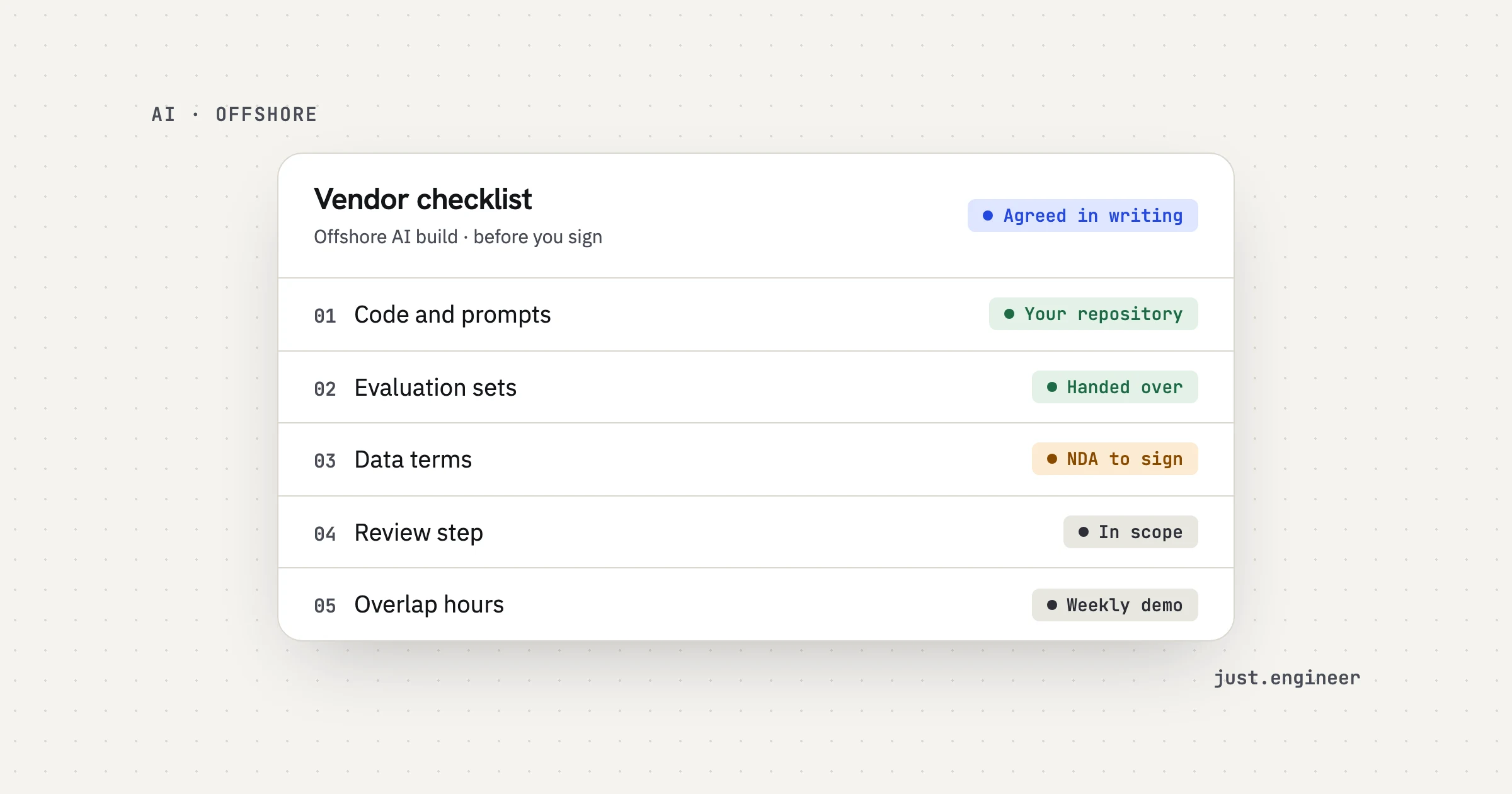
- Who owns the code, prompts and evaluation sets. All three should be yours, in your own repository from day one, with IP transfer in the agreement. Our clients own the code, the prompts and the evaluation sets.
- Data terms. Which model plans are used? Do the terms exclude training on your data? Whose accounts do the AI services run on? We use business API plans whose terms exclude training on your data, and AI services run on accounts you own. Agents get only the permissions their job needs.
- NDA timing. If you need an NDA, it should be signed before the first call, not after you have shared examples.
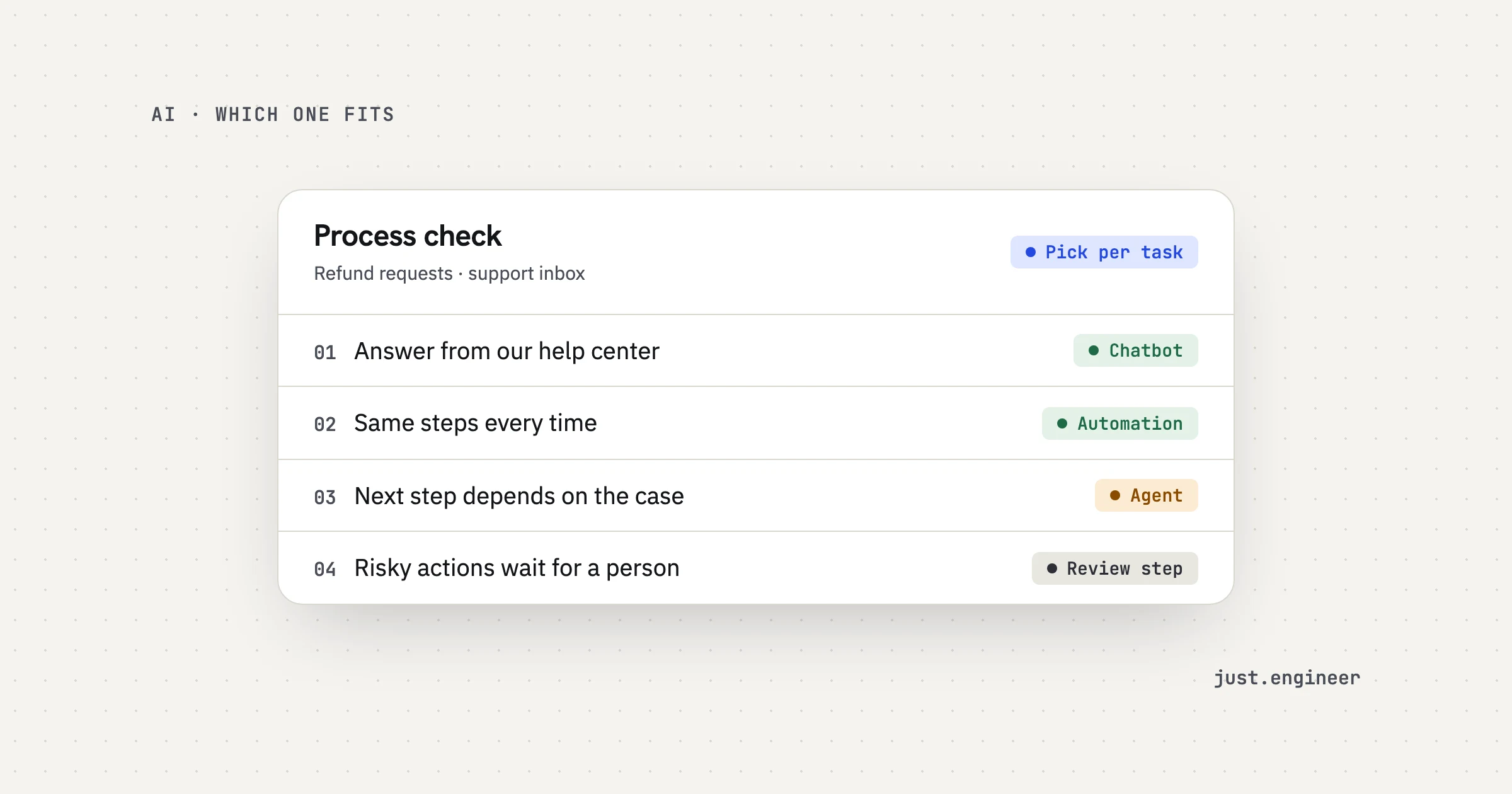
- Review steps. Which actions run alone and which wait for a person? Anything involving money, deletion or customers should be able to wait for approval, and every step should be logged.
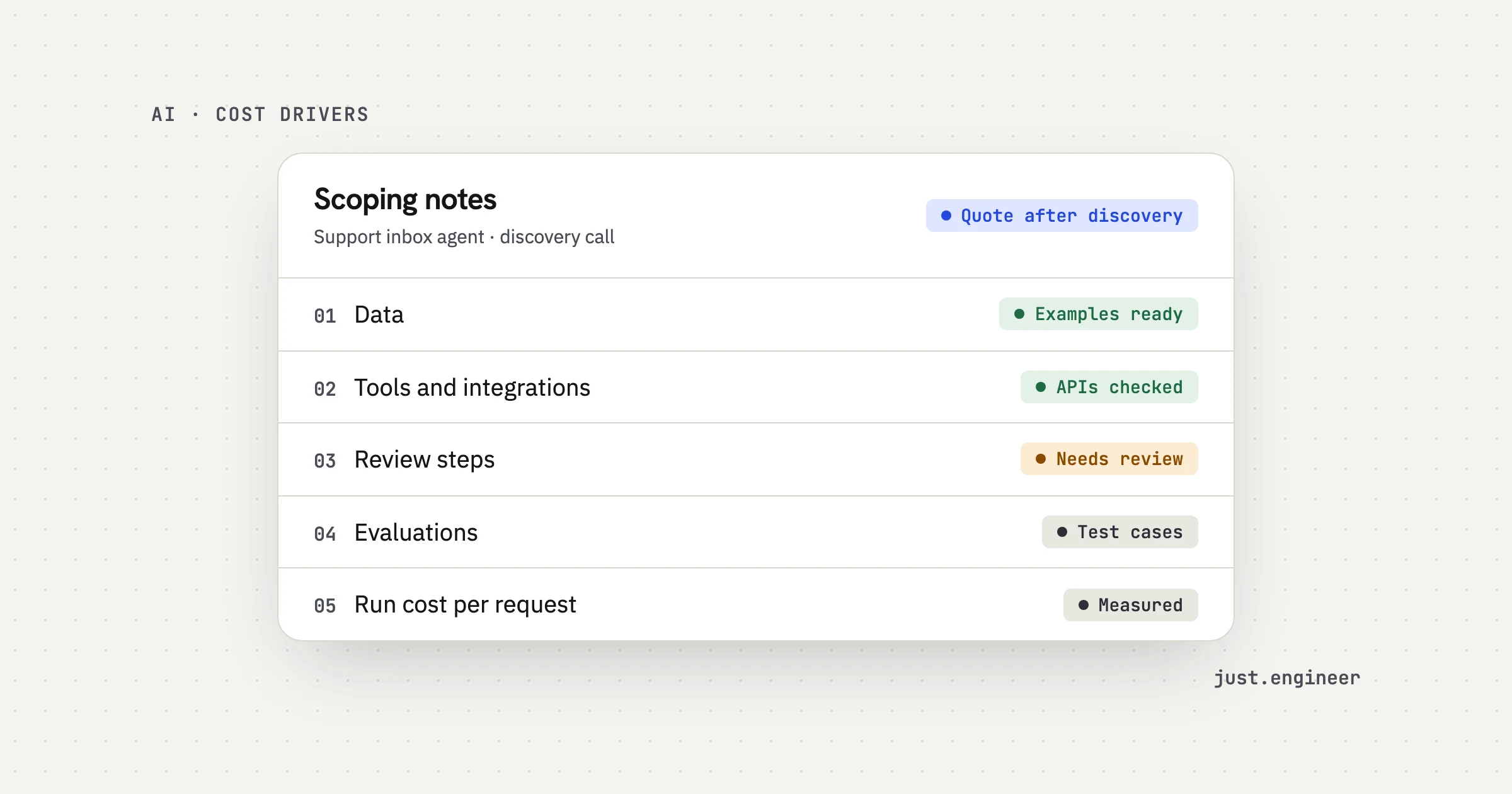
- Evaluations. How will the system be tested on your real cases, and who keeps the test set after launch? The method is covered in what drives AI agent development cost.
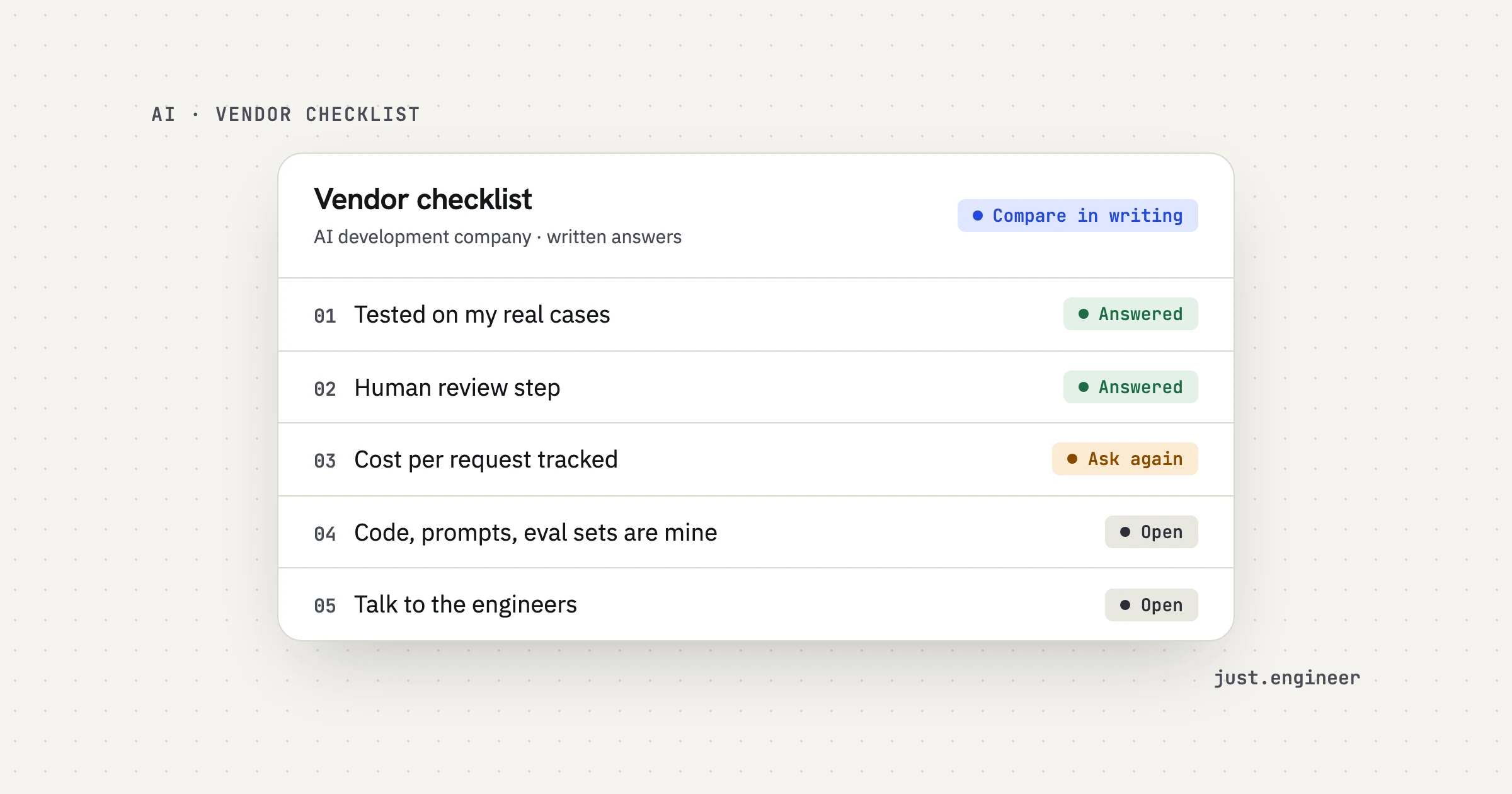
- Who you talk to. On your first call, are you talking to the people who build it, or to a sales team?
- Pricing shape. Fixed quote against hourly. Hourly billing for AI work is hard to predict, because the unknowns are in the data.
- What happens after launch. Documented code and a CI pipeline mean any team can take over, including yours.
Skip any of the first three and you can end up paying twice, once to build the system and once to get it back.
Time zones: Hanoi in practice
Hanoi is GMT+7. In practice:
- Singapore: overlap all day.
- Australia: overlap most of the day.
- Europe: mornings overlap with our working day.
- US: calls happen in our evening, so a US team meets us after dinner here.
The time difference rarely hurts a well-run project. What hurts is the lack of a rhythm. A weekly demo of working software, written decisions and one named owner on each side cover most of the gap. For US teams the evening call becomes the one fixed point in the week, and the rest runs asynchronously.
Vietnam’s engineering market in numbers
Vietnam is a real option, not only a cheap one. The figures below come from reports and press coverage of them, and each source defines its terms differently.
- The Ministry of Science and Technology counts about 74,000 IT enterprises employing more than 1.2 million workers, according to VnEconomy (May 2025).
- The same article cites the Vietnam IT market report on demand: the sector needs about 700,000 new personnel by 2025 while domestic training supplies about 500,000, a gap of 200,000 skilled workers.
- On pay, The Investor (September 2024) cites TopDev’s 2024-2025 report: developers average $1,100 to $3,000 a month, and AI engineers often earn well above that average.
- ITviec’s 2024-2025 salary report lists an AI and blockchain engineer with 4 years of experience at 37,750,000 VND a month. Its survey of 2,324 respondents ran from September 10 to October 10, 2024.
Read the numbers with care. They show a large workforce, a tight market for senior and AI talent, and pay that rises with experience. Do not read them as a price for a project. A developer’s salary is not what you pay an offshore team, and I am not giving a rate for ours. We quote AI work after a discovery call, and a quote covers the whole scope, with weekly demos on your real cases.
The tight market also affects retention. If you contract a team by the month, ask how long the engineers have been together and who replaces someone who leaves. In a studio that question matters less, because the fixed quote and handover documents carry the work.
A short decision rule
Choose in-house if the AI is your product and you can hire and keep the people who build it. Choose a studio if you have one well-defined process, want a first version tested on real cases, and prefer a fixed quote. Choose an offshore team if you already have a technical lead who will direct it. In all three, own the code, the prompts and the evaluation sets.
If you want to see how we run it, our AI services page lists what we build and how a project goes. A free 30-minute discovery call is the next step, and the engineers on that call are the ones who would build it. Bring a few real examples and we will tell you whether it is a fit, including when the answer is to hire.
Questions people ask
Is offshore AI development in Vietnam a good idea?
How is an offshore AI team different from hiring in-house?
Who owns the code and prompts when you build AI offshore?
What time zone overlap do I need with an offshore AI team?
How do I keep my data safe with an offshore AI developer?