Founders ask me some version of “AI agent vs chatbot: which one do I need?” about once a week. The honest answer is that there are three things hiding under that question, not two. A chatbot answers. A workflow automation follows fixed steps. An agent decides its own steps. Most sales pages blur them, because “agent” sells better than “automation”. This post gives you plain definitions, a comparison table and a checklist you can run on your own process.
AI agent vs chatbot vs workflow: plain definitions
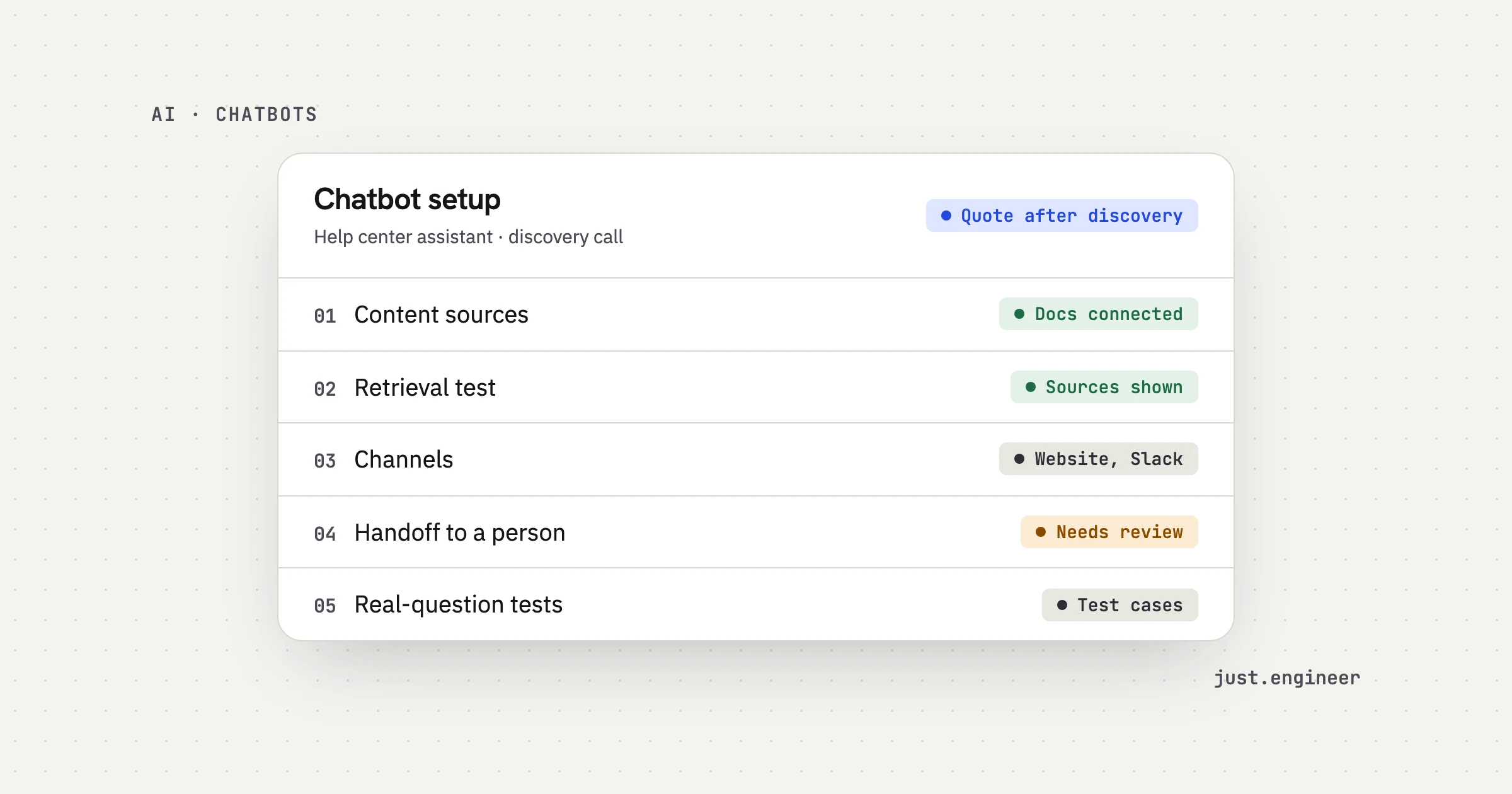
A chatbot answers questions. Someone types a question, and the system replies, ideally from your own documents, tickets and product data. It does not change anything in your systems. Our AI chatbots are built to answer only from your content, show the source, and say so when they can’t find an answer.
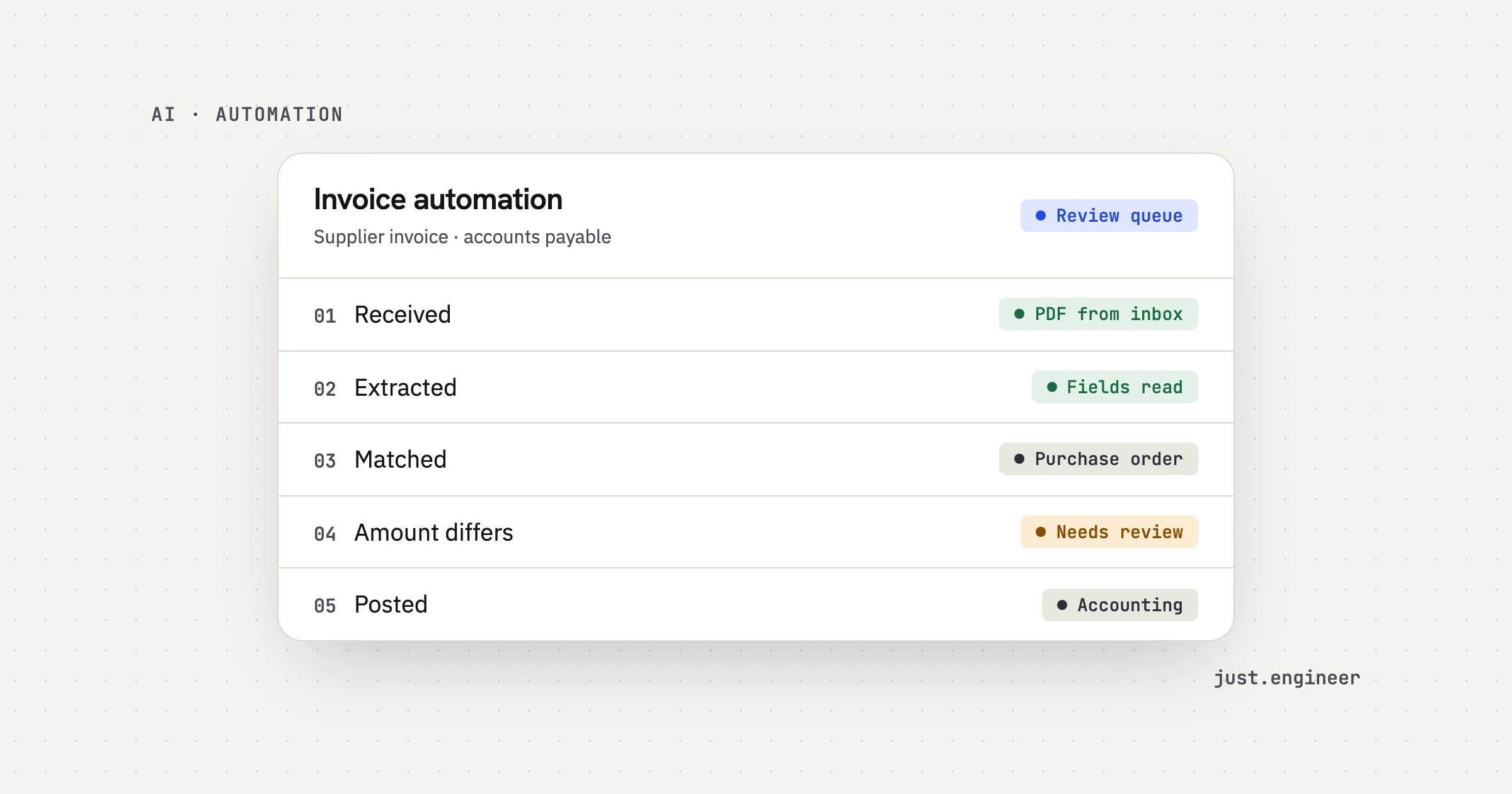
A workflow automation follows steps you defined. Something arrives, such as an invoice, a form or an email. The system extracts the fields, checks them against your data and writes them where they belong. The path is fixed. AI can sit inside one step, for example reading a messy PDF, and the process is still automation. Our automation work sends low-confidence fields to a person in a review queue.
An agent chooses its own steps. It reads the input, looks things up, decides what to do next and acts inside your tools. Anthropic, which builds Claude, draws the same line in its guide to building effective agents: workflows are “systems where LLMs and tools are orchestrated through predefined code paths”, while in agents “LLMs dynamically direct their own processes and tool usage.” Our AI agents ship with a review step, so you decide which actions run alone and which wait for a person.
The test I use is simple. Who decides the next step: you, in advance, or the system, at run time? If you can draw the whole path on a whiteboard before the first input arrives, it is automation. If the path depends on what the system finds, it is an agent. If nothing needs to happen except an answer, it is a chatbot.
Side by side
| Chatbot | Workflow automation | AI agent | |
|---|---|---|---|
| Main job | Answer questions | Move data through fixed steps | Decide and act across tools |
| Who picks the next step | The user, by asking | You, in advance | The system, at run time |
| Changes things in your systems | No | Yes, in set ways | Yes, within permissions you grant |
| Typical input | A question in plain language | A document, email or form | A request that needs judgment |
| Example | “Can I change my plan mid-cycle?” | Supplier invoice posted to accounting | Refund request triaged, looked up and drafted |
| Main risk | A wrong answer | A misread field | A wrong action |
| Where a person steps in | Handover when no answer is found | Review queue for unsure fields | Approval for risky actions |
| Easiest to test | Yes | Yes | Hardest |
The last row matters most. As you move from left to right, the system can do more, and there are more ways for it to be wrong. Anthropic says this directly: agentic systems “often trade latency and cost for better task performance”, and the autonomy of agents “means higher costs, and the potential for compounding errors.” Its advice is to find “the simplest solution possible” and add complexity only when it demonstrably improves outcomes.
Which one fits your process: a checklist
Pick one process, a real one that your team does this week, and answer these in order. Stop at the first row where you say yes.
- Do people mostly need an answer, with nothing changed in your systems? Examples: shipping policy, product specs, an internal handbook. Choose a chatbot.
- Can you write the steps down, and are they the same every time? Examples: invoices, bills of lading, onboarding forms. Choose workflow automation, with AI only in the steps that read messy input.
- Does the next step depend on what the system finds? Examples: a support ticket where the reply depends on the order, the customer and the refund policy. Choose an agent.
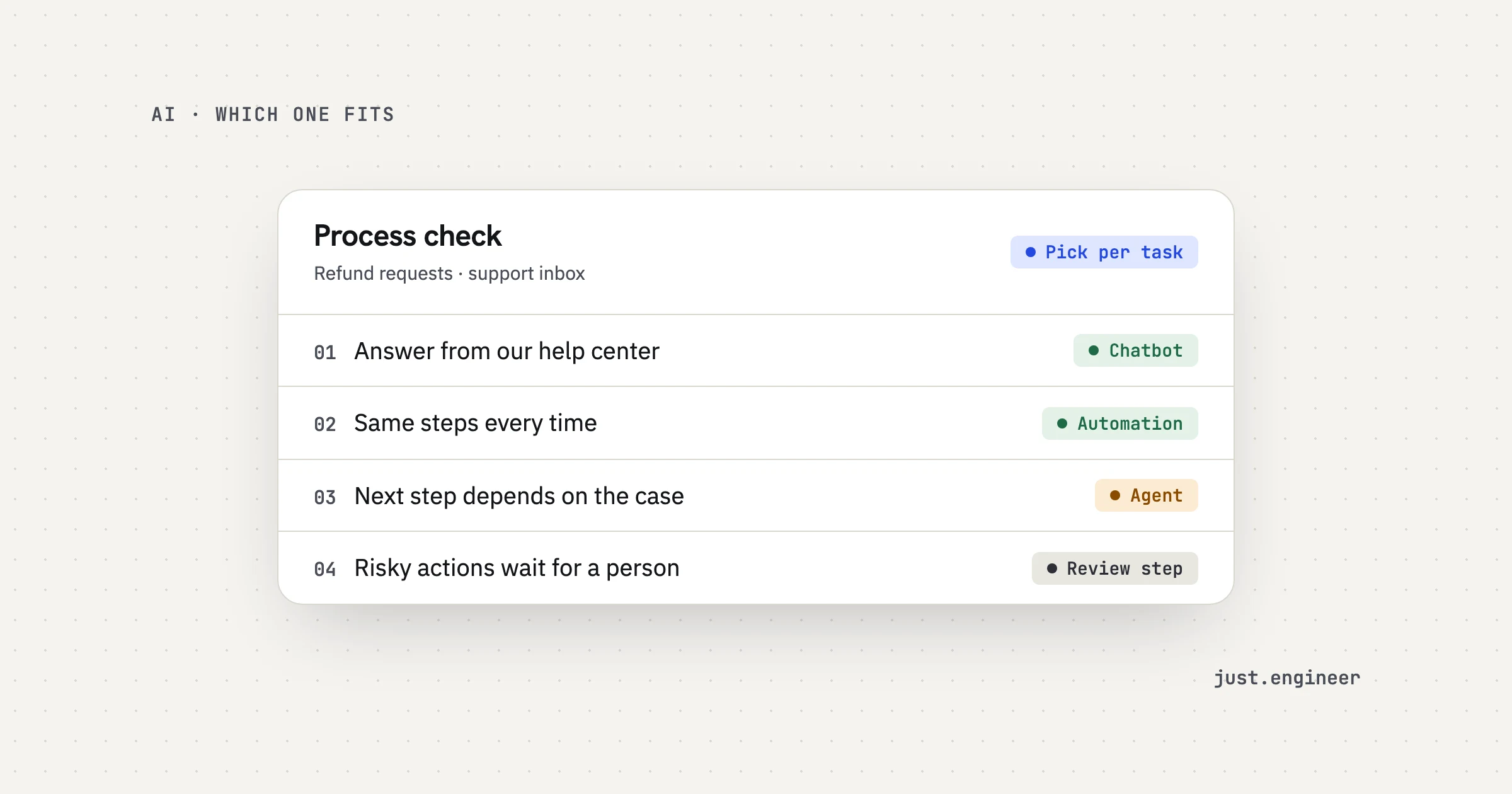
- Is it a mix? Most real processes are. Split the process into tasks and decide per task.
Then run four checks on whichever you picked:
- It happens often. Daily or weekly, not twice a year.
- It runs on text, documents or data. Emails, PDFs, tickets, forms, spreadsheets.
- A person reviews it today. You know what a right answer looks like.
- The tools can connect. They have an API, inbox, shared drive or database.
If you can’t say yes to those, none of the three is the right next step. High-stakes decisions where nobody can review the output are a bad fit for any of them. So is work that happens a few times a year, or data you can’t share or that doesn’t exist yet.
Three examples from the same business
Take an online shop with a small support team.
“Where is my order?” is a lookup. The customer asks, the system checks the order and courier status and replies with a tracking link. This can be a chatbot with access to order data, or a short workflow. It does not need an agent, because the path is the same every time.
“What is your return policy?” is a pure chatbot job. The answer lives in your help center, and the system should quote it and cite the page.
“I got the wrong item and I want a refund or a replacement.” is where an agent earns its cost. The system has to read the message, find the order, check the policy, see whether the item is in stock, and draft the right reply. Anything involving money or a customer should wait for a person to approve it. The decision changes with each case, so a fixed path would break.
Most shops need all three, in that order of volume. The first two are easier to scope and easy to test (see what shapes AI chatbot development cost). The third is worth doing once the first two are working.
My opinion: start one step to the left
Here is the position I hold, and I hold it firmly. Most teams that ask for an agent need a chatbot or a workflow first, and should build that one first.
My reasoning is practical. A chatbot or a workflow is easier to test, because the right answer is known in advance and you can score it against a set of real examples. It is cheaper to run, because each request makes fewer model and tool calls. And its failures are smaller: a wrong answer in a chat is a much smaller problem than a wrong action in your CRM. You also learn what your data and tools really look like, which is the information you need to build a good agent later.
I am not against agents. We build them. But I would rather a client reach an agent after two quiet, working systems than start there and spend the first months finding out that the inbox data was messier than anyone thought.
I am not alone in thinking the label gets ahead of the need. Gartner analyst Anushree Verma said that “many use cases positioned as agentic today don’t require agentic implementations”, in a forecast reported by Outlook Business that more than 40% of agentic AI projects will be cancelled by the end of 2027. The same report cites escalating costs, unclear business value and inadequate risk controls as the reasons. Gartner also warns of “agent washing”, where companies relabel assistants and automation as agents.
What changes when you build each one
The three differ in what you have to get right before launch.
- Chatbot: your content has to be current and findable. The work is mostly search, source links and testing on your real questions.
- Automation: your inputs have to be readable, and you need a clear rule for what goes to a person. Accuracy is measured on your documents before launch.
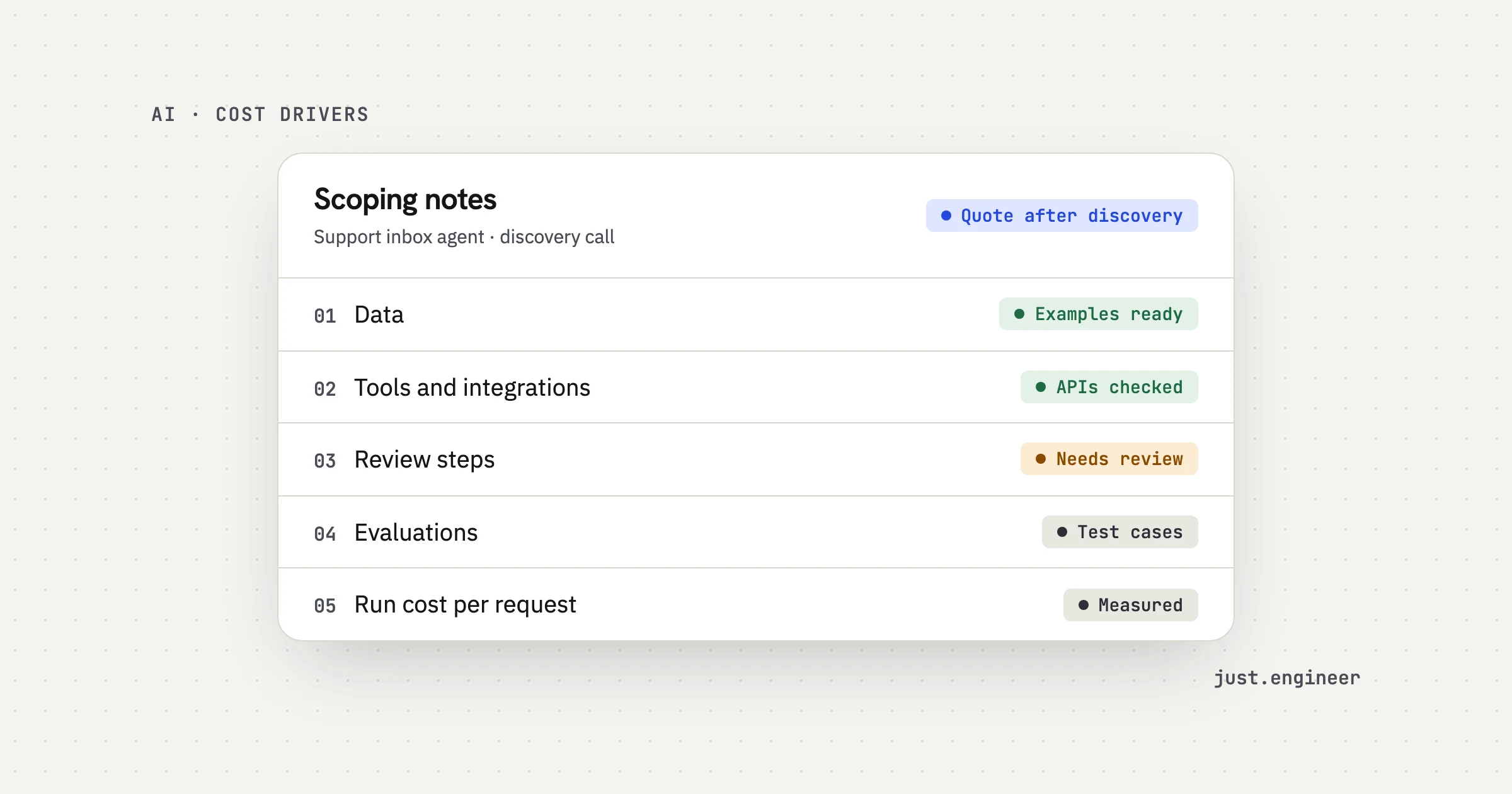
- Agent: you need tools it can use, permissions it should have, a review step for risky actions and an evaluation set. The review step and the evaluations are the parts people try to cut. I would not cut either (we cover why in what drives AI agent development cost).
For all three, we start the same way: a free discovery call where we map the process, look at real examples and check the data and tools. Then comes a scoped proposal with a fixed quote, before we build. We don’t publish a price or timeline for AI work, because it depends on the process, your data and your tools.
How to decide this week
- Write down the process in plain steps, as you would tell a new hire.
- Mark each step as “answer”, “fixed move” or “judgment call”.
- Collect a few dozen real examples, with what a person did with each.
- Build for the dominant type first. Add the next type only after the first works.
If the steps are mostly answers, you want a chatbot. If they are mostly fixed moves, you want automation. If many are judgment calls across different tools, you want an agent, with a person approving the risky ones.
Our wider AI services cover all of these, plus AI features added to an app you already have. If you have a process that happens every day, runs on text or documents, and a person reviews it today, bring a few real examples to a call and we will tell you which shape it is, including when the answer is “not an agent”.
Questions people ask
What is the difference between an AI agent and a chatbot?
Is workflow automation the same as an AI agent?
Should I start with a chatbot or an agent?
Can one system be a chatbot, a workflow and an agent?
Do AI agents replace chatbots?